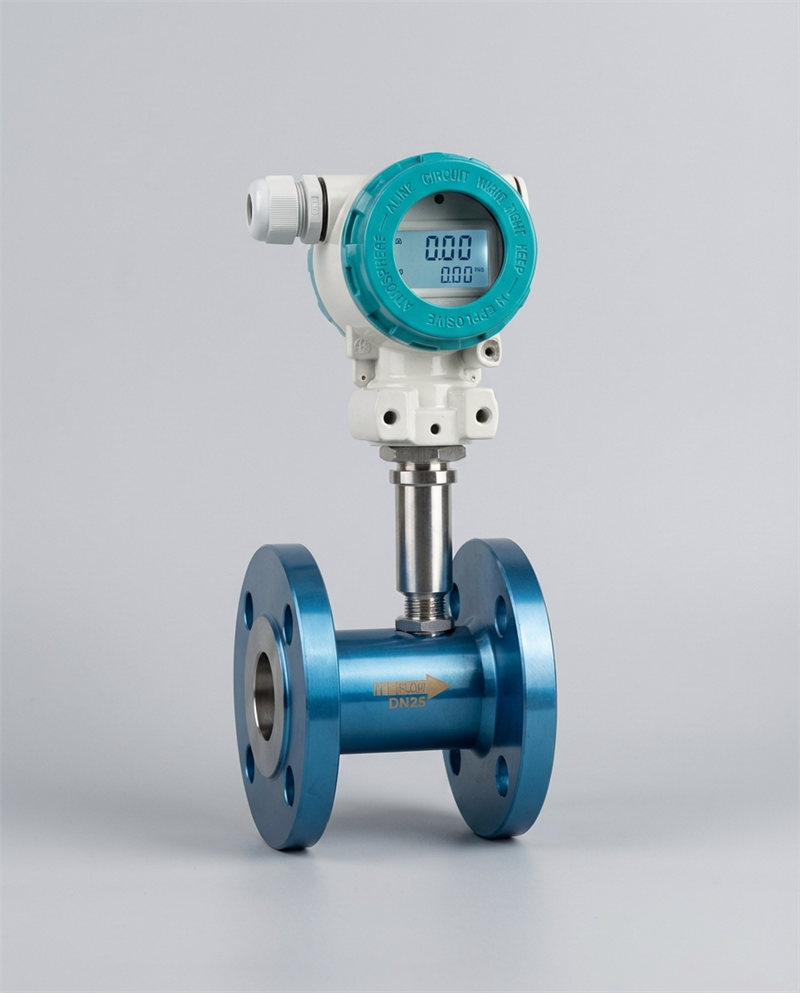
Q1: What is the difference between a turbine flow meter and other flow measurement technologies like electromagnetic or vortex meters?
A: Turbine flow meters use a mechanical rotor suspended in the flow stream that rotates at a speed proportional to volumetric flow rate, offering exceptional accuracy (±0.5% or better) and excellent repeatability (±0.2%) across a 10:1 turndown ratio. They are ideal for clean to moderately dirty liquids with viscosities from 0.3 to 100 cSt, making them the preferred choice for custody transfer of petroleum products, chemical batching, and applications requiring the highest precision. Electromagnetic flowmeters measure conductive liquids using Faraday’s law of electromagnetic induction with no moving parts and no pressure drop, offering wider rangeability (100:1 or more) but requiring minimum conductivity (typically >5 μS/cm) and delivering slightly lower accuracy (±0.5-1.0%). Vortex shedding meters work for liquids, gases, and steam using vortex frequency measurement with no moving parts, but offer lower accuracy (±1-2%) and narrower rangeability (10:1) compared to turbine meters. Choose turbine meters when you need maximum accuracy for clean liquid measurement and can accommodate the periodic bearing maintenance; choose electromagnetic for dirty liquids, slurries, or corrosive chemicals where no obstruction is desired; choose vortex for steam applications or where maintenance-free operation is prioritized over accuracy.
Q2: How accurate are Jade Ant turbine flow meters, and what affects their accuracy over time?
A: Jade Ant Liquid Turbine Flow Meters deliver industry-leading ±0.5% accuracy as standard, with ±0.25% accuracy available on select sizes for custody transfer and precision applications. This accuracy is maintained across the full 10:1 flow range from minimum to maximum flow, with exceptional ±0.2% repeatability ensuring consistent performance batch after batch. Accuracy is verified through multi-point calibration using NIST-traceable flow standards, with calibration data and meter coefficient stored in non-volatile memory and documented on a traceable certificate. Over time, accuracy can be affected by several factors: bearing wear from friction and contamination gradually increases rotor drag, causing low readings; deposits on rotor blades or in the flow path add weight and change aerodynamic characteristics; erosion from abrasive particles degrades blade geometry; and sensor drift or electrical issues can affect pulse detection. Proper installation with adequate filtration, regular maintenance including bearing inspection and replacement every 3-5 years, and periodic calibration verification (annually for custody transfer, every 2-3 years for general applications) ensure accuracy remains within specification throughout the meter’s 10-15 year service life.
Q3: What liquids can turbine flow meters measure, and what are the limitations?
A: Jade Ant turbine flow meters accurately measure a vast range of liquids including water (clean, treated, demineralized, WFI), petroleum products (gasoline, diesel, jet fuel, kerosene, crude oil, lubricating oils), chemicals (solvents, acids, bases, alcohols, glycols), food and beverage liquids (beer, wine, juices, milk, edible oils, syrups), pharmaceuticals (solvents, APIs, formulation ingredients), and industrial fluids (hydraulic oils, coolants, cutting fluids, heat transfer fluids). The liquid must be single-phase (no gas bubbles or vapor) and homogeneous (no settling solids or phase separation). Viscosity range is typically 0.3 to 100 cSt; higher viscosities can be measured with reduced accuracy and turndown, while very low viscosities (<0.3 cSt like liquid CO₂ or cryogenic fluids) may cause bearing lubrication issues. The liquid should be clean or adequately filtered—suspended solids, fibers, or abrasive particles accelerate bearing wear and damage precision rotor blades. Corrosive liquids require appropriate material selection (316L stainless steel, Hastelloy, titanium, or coated surfaces). Non-conductive liquids are fine (unlike electromagnetic meters which require conductivity), and the liquid must remain liquid at operating conditions without vaporization or freezing. Slurries, multi-phase flows, highly viscous liquids (>100 cSt), and liquids that polymerize or crystallize in the meter are not suitable for turbine measurement—consider electromagnetic, positive displacement, or other technologies for these applications.
Q4: How often do bearings need to be replaced, and what is involved in bearing replacement?
A: Bearing replacement intervals depend heavily on operating conditions. For clean, low-viscosity liquids (water, light hydrocarbons, solvents) with good upstream filtration, ceramic bearings typically last 3-5 years in continuous service or 5-10 years in intermittent service. Tungsten carbide bearings in demanding applications can extend life by 50-100%. Dirty liquids with suspended solids, abrasive particles, or corrosive contaminants may require annual bearing replacement or even more frequently. High-viscosity liquids increase bearing load and reduce lubricating film thickness, accelerating wear. Very high flow rates approaching the meter’s maximum capacity increase bearing loads and friction heating. As a preventive maintenance best practice, inspect bearings every 2 years and plan replacement every 3-5 years based on condition assessment and operating hours. The bearing replacement process involves shutting down flow and draining the meter, removing it from the pipeline (if not designed for in-line servicing), carefully disassembling the meter body following manufacturer procedures, removing the rotor assembly and old bearings, cleaning all surfaces, installing new precision-matched bearing sets using proper techniques and tools, reassembling with new seals and gaskets, and performing flow verification or recalibration before return to service. Jade Ant provides complete bearing kits including matched bearings, seals, detailed instructions, and installation fixtures. Many customers send meters to Jade Ant factory service for bearing replacement combined with comprehensive inspection, cleaning, and recalibration—typical turnaround is 2-3 weeks with loaner meters available to maintain operational continuity.
Q5: Can turbine meters be used for custody transfer and fiscal metering applications?
A: Yes, Jade Ant Liquid Turbine Flow Meters are widely used for custody transfer and fiscal metering in the petroleum industry, where accurate measurement directly impacts revenue and regulatory compliance. These meters meet the stringent requirements of API MPMS Chapter 5.3 (Measurement of Liquid Hydrocarbons by Turbine Meters), ISO 4185 (Liquid Flow Measurement in Closed Conduits – Weighing and Volumetric Methods), OIML R117 (Measuring Systems for Liquids Other Than Water), and various national custody transfer standards. For custody transfer certification, the meter must be initially calibrated at an accredited laboratory using NIST-traceable master meters or gravimetric standards, with testing performed at multiple flow points across the operating range and documented on a traceable calibration certificate. Installation must follow strict requirements including adequate straight pipe (typically 20D upstream, 10D downstream), temperature compensation for volumetric correction, and often pressure compensation and density measurement for mass or standard volume calculation. The meter must be proven (verified) at regular intervals—typically annually or after a specified throughput volume—using a displacement prover (pipe prover or compact prover) to confirm accuracy remains within tolerance (typically ±0.25% for custody transfer). Proving procedures must follow API MPMS Chapter 4 requirements with documented proving reports submitted to regulatory authorities. Jade Ant provides full documentation support including material certificates, calibration certificates, proving procedures, and technical specifications required for custody transfer approval. For the highest accuracy custody transfer applications, we offer ±0.25% accuracy meters with extended calibration and temperature compensation optimized for petroleum products.
Q6: What installation requirements are critical for achieving rated accuracy?
A: Proper installation is essential for turbine meter accuracy. The most critical requirement is adequate straight pipe: minimum 10D upstream and 5D downstream for general applications, with 20D upstream and 10D downstream recommended for custody transfer or when installing after flow disturbances like valves, pumps, or elbows. Flow conditioners installed 5D upstream can reduce straight pipe requirements when space is limited. The meter must be installed with correct flow direction (arrow on body must match liquid flow direction), in a section of pipe that remains completely filled with liquid (no partially filled pipes or high points where vapor can accumulate), and preferably horizontal to ensure even bearing wear. Use pipe supports within 2-3 diameters of the meter to prevent stress from pipe weight and thermal expansion—never use the meter as a pipe support. Install isolation valves upstream and downstream for meter removal, and include a strainer or filter (100-200 micron) upstream to protect bearings and rotor from debris. For pulsating flow from reciprocating pumps, install pulsation dampeners. Ensure the meter is electrically grounded (<1Ω resistance) and wired correctly according to specifications. For custody transfer, temperature sensors must be installed per API requirements (typically in a thermowell downstream of the meter), and pressure taps positioned correctly for accurate compensation calculations. Fill the system slowly to avoid overspeeding the rotor, purge all air completely, and verify installation with initial flow testing before putting into service.
Q7: How do I select the right meter size for my application?
A: Selecting the proper meter size ensures optimal accuracy and longevity. Unlike some flowmeter technologies that benefit from downsizing, turbine meters should generally match your pipe size or be one size smaller, operating in the middle to upper portion of their flow range for best accuracy and bearing life. First, determine your actual flow requirements: minimum flow (lowest flow requiring accurate measurement), normal operating flow (typical or average flow during regular operation), and maximum flow (peak demand that must be accommodated). Compare these flows against the published flow ranges for each meter size—your minimum flow should be above the meter’s minimum rated flow, your normal flow should fall in the middle 30-70% of the range for optimal accuracy, and your maximum flow must not exceed the meter’s maximum rated flow (which could overspeed and damage bearings). Consider the liquid’s viscosity: high-viscosity liquids may require upsizing to reduce pressure drop and bearing loads, while the published flow ranges assume water-like viscosity (1 cSt). Account for future capacity expansion if process flows are expected to increase. For applications with highly variable flows, the 10:1 turndown ratio provides flexibility, but consistent operation near minimum flow indicates you should downsize, while frequent maximum flow operation suggests upsizing. Contact Jade Ant applications engineering with your specific requirements—liquid type and properties, viscosity and temperature, minimum/normal/maximum flow rates, operating pressure, pipe size, and application type (batching, continuous, custody transfer)—and we will recommend the optimal meter size with performance predictions including accuracy, pressure drop, and bearing life estimates.
Q8: What communication and output options are available?
A: Jade Ant turbine flow meters offer comprehensive output and communication options for flexible integration with control systems. Standard outputs include 4-20mA analog output (isolated or non-isolated, user-selectable active or passive configuration) that can be scaled to represent flow rate, temperature, or any measured parameter—maximum loop resistance is typically 500-750Ω depending on configuration. Pulse/frequency output (passive transistor NPN/PNP or active relay contact) provides high-resolution totalization with user-programmable scaling from 0.001 to 100,000 pulses per unit volume, ideal for batch controllers, counters, and PLC integration—maximum frequency is typically 5000 Hz. The built-in display shows simultaneous flow rate (in user-selected engineering units including L/min, m³/h, GPM, BBL/day, kg/h, and 20+ others), cumulative totalizer (resettable batch total and non-resettable grand total), temperature if equipped, and diagnostic status. Digital communication protocols available at time of order include Modbus RTU over RS485 (most common, simple integration with SCADA and PLC), HART protocol (superimposed on 4-20mA signal for simultaneous analog and digital communication, ideal for configuration and diagnostics), and Profibus DP (high-speed fieldbus for advanced process automation). Optional Ethernet/IP and Modbus TCP provide direct network connectivity. Most models support simultaneous multiple outputs—for example, 4-20mA + pulse + Modbus—allowing independent connections to recorders, controllers, and monitoring systems without signal splitting. Programmable alarm relays (typically 2 outputs) provide high/low flow alarms, totalizer preset triggering for batch control, or fault indication for diagnostics.
Q9: Can Jade Ant turbine meters be used in hazardous (explosive) areas?
A: Yes, Jade Ant Liquid Turbine Flow Meters are available with comprehensive hazardous area certifications for safe installation in locations where flammable liquids or vapors may be present. Available certifications include ATEX (European Union): Ex d IIB/IIC T4-T6 Gb for Zone 1 flameproof (explosion-proof) enclosure, and Ex ia IIC T4 Ga for Zone 0 intrinsically safe applications where the entire meter and wiring are incapable of igniting the atmosphere. IECEx (International): globally recognized certification valid in 34+ countries through the IECEx scheme, facilitating international installations. FM Approvals (North America): Class I Division 1 Groups A,B,C,D for hazardous locations in the United States, and Class I Zone 0/1 AEx certifications. CSA (Canada): Class I Division 1 Groups B,C,D for Canadian installations. The hazardous area certification must be specified at time of order, as it requires special enclosure construction, certified cable glands, specific electronic component ratings, and documentation that cannot be retrofitted to standard meters. Installation in hazardous areas must follow strict requirements including use of explosion-proof conduit and fittings (for Ex d installations), proper sealing to prevent vapor migration, intrinsically safe barriers or isolators (for Ex ia installations), verified grounding with resistance <1Ω, and adherence to temperature class ratings to prevent surface temperatures from exceeding safe limits for the classified gases. Provide your area classification (Zone/Division, Gas Group, Temperature Class) when ordering so Jade Ant can configure the meter with appropriate certification and provide installation documentation and guidelines for compliant installation.
Q10: What is the warranty and what after-sales support does Jade Ant provide?
A: Jade Ant provides a comprehensive 2-year warranty from date of shipment covering manufacturing defects, material defects, and electronic component failures under normal operating conditions and proper installation. The warranty includes repair or replacement of defective components, return shipping, and technical support to diagnose and resolve issues. Extended warranty up to 5 years is available for purchase at time of order. The warranty does not cover damage from improper installation (reverse flow, overspeed, inadequate filtration), operation outside specifications (excessive temperature/pressure, incompatible liquids, abrasive service), normal wear items (bearings after expected service life, seals and gaskets), unauthorized modifications or repairs, or physical damage from external causes. Beyond warranty coverage, Jade Ant offers extensive after-sales support including free lifetime technical support via phone and email with applications engineers typically responding within 4 business hours; remote diagnostics and troubleshooting assistance using meter diagnostic data; field service available in major regions for installation supervision, commissioning assistance, and on-site training; factory calibration and repair services with 2-3 week turnaround (expedited service available); bearing replacement kits and spare parts with global availability; and comprehensive documentation including operation manuals, maintenance procedures, troubleshooting guides, and calibration certificates. For custody transfer applications, we provide proving procedure development, witness testing, and regulatory documentation support. Loaner meters are available for critical applications during service periods to maintain operational continuity. Contact your regional Jade Ant office or our headquarters technical support team for assistance with any installation, operation, maintenance, or application questions—we’re committed to ensuring your turbine flow meters deliver accurate, reliable measurement throughout their service life.