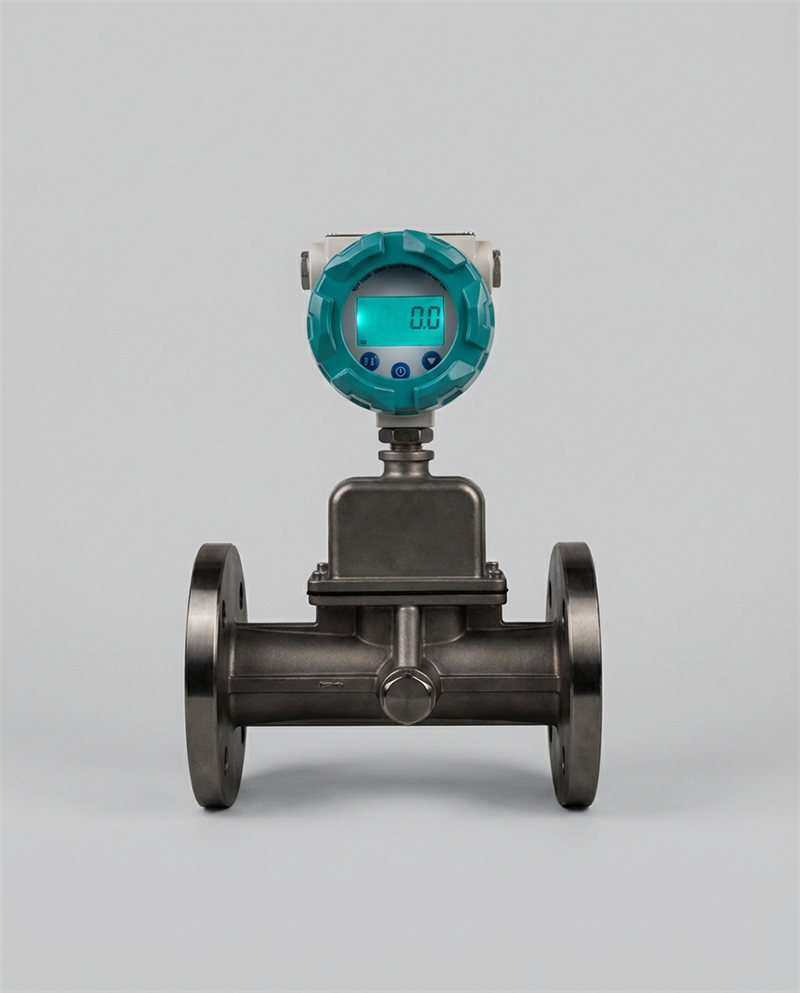
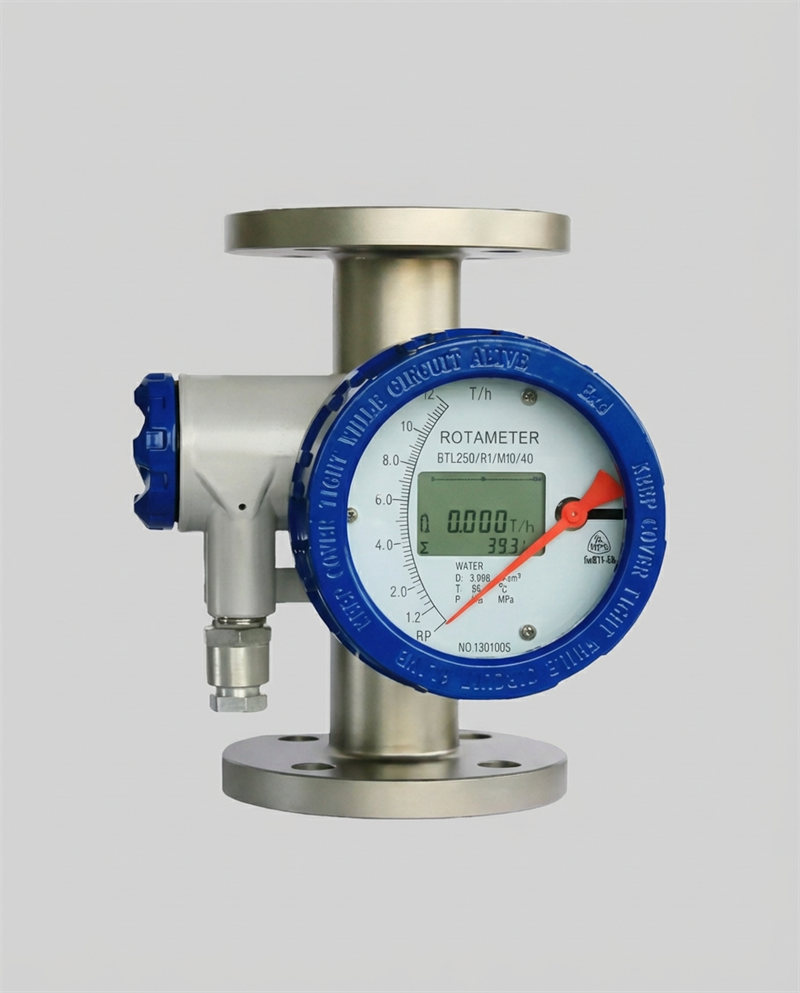
Wide Measurement Range with Exceptional Turndown Ratio
The Jade Ant swirling vortex flowmeter delivers an industry-leading turndown ratio of 30:1, far exceeding the typical 10:1 capability of traditional gas meters. This exceptional rangeability means a single meter accurately measures from very low to very high flow rates without requiring multiple meter sizes or parallel installations.
Practical Benefits:
- Accommodate process variability: Handle seasonal demand changes, batch processes, and startup/shutdown conditions with a single meter
- Reduce inventory requirements: Fewer meter sizes needed to cover your full flow range
- Simplify system design: Eliminate complex parallel meter arrangements with automatic switchover valves
- Maintain accuracy during turndown: Unlike orifice plates that lose accuracy at low flows, Jade Ant swirling vortex maintains ±1.0% accuracy from minimum to maximum flow
Example: A DN100 (4-inch) swirling vortex meter with a maximum flow of 1500 m³/h can accurately measure down to 50 m³/h, covering typical natural gas consumption variations from nighttime baseline to peak daytime demand without sacrificing accuracy.
The wide rangeability also provides future-proofing for installations where gas consumption may increase over time—the same meter continues performing accurately as demand grows, eliminating costly replacements.
No Moving Parts – Maintenance-Free Operation
Unlike turbine meters, rotary meters, or diaphragm meters that contain mechanical components subject to wear, the Jade Ant swirling vortex flowmeter has absolutely no moving parts. The measurement principle relies entirely on fluid dynamics—gas flowing through precision-machined spiral vanes creates a rotating vortex whose precession frequency is detected by stationary piezoelectric sensors.
Longevity Benefits:
- No bearing wear: Eliminates the primary failure mode of turbine meters
- No calibration drift from wear: Mechanical wear in moving parts causes gradual calibration changes; swirling vortex geometry remains constant
- Extended service life: Field installations demonstrate reliable operation for 15+ years without recalibration
- Reduced maintenance cost: No scheduled bearing lubrication, rotor replacement, or diaphragm renewal
- Zero downtime: No periodic shutdowns required for component replacement
Cost Savings Analysis: Over a 10-year lifecycle, a typical turbine meter requires:
- Bearing replacement every 2-3 years: $2,000-3,000 per event
- Annual recalibration or verification: $1,500-2,500 per year
- Total maintenance cost: $20,000-30,000
Jade Ant swirling vortex meter over same period:
- No bearing maintenance: $0
- Verification calibration (optional): $2,000 every 5 years = $4,000 total
- Total savings: $16,000-26,000 per meter
For large facilities with dozens of gas meters, maintenance-free operation translates to hundreds of thousands of dollars in lifecycle cost savings.
Superior Low Flow Sensitivity
The swirling vortex principle provides exceptional sensitivity to low flow rates, detecting flows as low as 0.5 m/s gas velocity while maintaining measurement accuracy. This low-flow capability offers critical advantages:
Leak Detection: In natural gas distribution systems, pipeline leaks often manifest as persistent low flows during periods when consumption should be zero. The Jade Ant swirling vortex meter’s sensitivity allows detection of:
- Small continuous leaks (as low as 1-2% of full scale)
- Unauthorized tapping or diversion
- Valve seat leakage in supposedly closed systems
Pilot Flow Measurement: Many combustion processes require accurate measurement of small pilot flows:
- Burner pilot gas (typically 1-5% of main flame flow)
- Purge gas to safety systems
- Instrument air for control valves and pneumatic instruments
Nighttime/Weekend Baseline Monitoring: For industrial facilities, measuring nighttime baseline consumption reveals waste:
- Equipment left running unnecessarily
- Process leaks and inefficiencies
- Opportunities for demand management
The combination of wide turndown ratio (30:1) and low minimum flow detection creates a meter that literally “sees everything” from the smallest leak to peak demand, providing comprehensive visibility into gas consumption patterns.
Integrated Temperature & Pressure Compensation
Gas density varies significantly with temperature and pressure changes. Without compensation, volumetric flow measurements can introduce substantial errors in mass flow determination and billing. Jade Ant swirling vortex flowmeters feature factory-integrated temperature and pressure sensors that continuously monitor process conditions and automatically compensate for density changes.
Compensation Capabilities:
Temperature Measurement:
- Integrated PT100 or PT1000 RTD sensor (Class A accuracy)
- Temperature range: -20°C to +350°C
- Response time: <10 seconds for thermal equilibrium
- Position: Directly in flow stream for accurate gas temperature
Pressure Measurement:
- Integrated piezoresistive or capacitive pressure transmitter
- Pressure ranges: 0-0.6 MPa to 0-6.3 MPa (field selectable)
- Accuracy: ±0.5% full scale
- Absolute or gauge pressure measurement
Automatic Calculations: The intelligent microprocessor uses measured temperature and pressure to:
- Calculate actual gas density using the ideal gas law or compressibility-corrected equations
- Convert actual volumetric flow to standard volumetric flow (at reference conditions, typically 0°C/101.325 kPa or 15°C/101.325 kPa)
- Calculate mass flow rate (kg/h, lb/h) for process control
- Totalize mass and standard volume for accurate billing
Accuracy Impact: Without compensation, a natural gas system experiencing:
- Temperature variation: 5°C to 35°C
- Pressure variation: 0.3 MPa to 0.8 MPa
Would see density changes of ±40% or more, making uncompensated volumetric measurement essentially useless for custody transfer or billing applications.
With Jade Ant’s integrated compensation, compensated mass flow accuracy remains ±1.5% across the full range of temperature and pressure variations, ensuring fair and accurate measurement under all operating conditions.
Regulatory Compliance: Integrated T&P compensation ensures compliance with:
- ISO 5167 gas measurement standards
- AGA Report No. 7 (turbine meter standards)
- OIML R137 (gas meters for fiscal metering)
- Local utility and regulatory requirements for custody transfer
Advanced Digital Signal Processing
The Jade Ant swirling vortex flowmeter incorporates a powerful 32-bit ARM microprocessor running sophisticated proprietary algorithms that deliver superior measurement performance compared to analog or simple digital processing.
Signal Processing Features:
Fast Fourier Transform (FFT) Analysis:
- Converts time-domain pressure signal to frequency spectrum
- Identifies the characteristic precession frequency peak with high resolution
- Rejects noise, vibration, and interference through spectral analysis
- Provides exceptional signal-to-noise ratio even in challenging installations
Adaptive Filtering:
- Automatically adjusts filtering based on flow stability and signal characteristics
- Increases damping during transient conditions to prevent erratic output
- Reduces damping during steady flow for fast response
- Optimizes the balance between stability and response time
Multi-Point Linearization:
- Applies 20+ point linearization curve across measurement range (not just 2-point)
- Compensates for minor non-linearities in vortex generation at extreme flows
- Ensures ±1.0% accuracy from minimum to maximum flow
- Custom linearization available for specific gas compositions
Self-Diagnostic Monitoring: The intelligent processor continuously monitors:
- Signal strength: Warns if vortex signal becomes weak (low flow or sensor contamination)
- Signal quality: Detects excessive noise indicating vibration or installation problems
- Sensor integrity: Verifies temperature and pressure sensor functionality
- Electronic health: Monitors power supply, memory, and processing functions
- Configuration validity: Checks that programmed parameters are within acceptable ranges
Diagnostic Alarms: Configurable warnings and faults alert operators to:
- Low signal strength (flow below minimum or measurement unreliable)
- Temperature/pressure sensor failure
- Out-of-range process conditions
- Electronic malfunction requiring service
- Configuration errors
Data Logging: Internal non-volatile memory stores:
- Flow rate history (hourly, daily averages)
- Totalizer values with timestamp
- Alarm events with date/time
- Configuration change log
- Diagnostic data for troubleshooting
Up to 10,000 records can be stored and retrieved via communication interface for trend analysis, verification, and regulatory reporting.
Minimal Straight Pipe Requirements
Traditional gas measurement technologies impose significant straight pipe requirements that complicate installation and increase cost:
- Orifice plates: Typically 20D upstream, 5D downstream
- Turbine meters: 10-20D upstream, 5D downstream
- Ultrasonic meters: 10-20D upstream, 5D downstream
The Jade Ant swirling vortex flowmeter’s unique measurement principle requires only:
- 5D upstream minimum
- 2D downstream minimum
Installation Advantages:
Reduced Piping Costs: For a DN100 (4-inch) meter:
- Traditional meter: 20D upstream = 2.0 meters of straight pipe
- Jade Ant swirling vortex: 5D upstream = 0.5 meters of straight pipe
- Savings: 1.5 meters of piping, supports, and installation labor
For large meters (DN200, DN300), the cost savings multiply substantially.
Easier Retrofits: Existing installations often lack adequate straight pipe for traditional meters. The short straight pipe requirement allows:
- Installation in constrained spaces
- Replacement of existing meters without piping modifications
- Mounting close to walls, equipment, or other obstructions
Flexible Location Selection: Less stringent piping requirements provide more options for:
- Accessible mounting locations for maintenance
- Protected indoor locations rather than exposed outdoor runs
- Close proximity to electrical power and communication infrastructure
Flow Conditioner Option: For installations where even 5D straight pipe cannot be achieved, Jade Ant offers an integrated flow conditioner that reduces the upstream requirement to just 3D while maintaining accuracy within specification.
Explosion-Proof and Intrinsically Safe Designs
For installations in hazardous areas where flammable gases may be present, Jade Ant offers comprehensive explosion-proof and intrinsically safe configurations certified to international standards.
Available Certifications:
ATEX (European Union):
- Zone 0: Ex ia IIC T4 Ga (intrinsically safe for continuous gas presence)
- Zone 1: Ex d IIC T4-T6 Gb (flameproof enclosure for normal operation)
- Zone 2: Ex nA IIC T4 Gc (non-sparking construction)
- Gas groups: IIA, IIB, IIC (including hydrogen)
- Temperature classification: T1-T6 (depending on operating conditions)
IECEx (International):
- Ex ia IIC T4 Ga (intrinsically safe)
- Ex d IIC T4 Gb (flameproof)
- Recognized in 34+ countries through IECEx certification scheme
FM Approvals (North America):
- Class I, Division 1, Groups A, B, C, D
- Class I, Division 2, Groups A, B, C, D
- Class I, Zone 0, AEx ia IIC T4
- Class I, Zone 1, AEx d IIC T4
CSA (Canada):
- Class I, Division 1, Groups B, C, D
- Class I, Division 2, Groups A, B, C, D
NEPSI (China):
- Ex d IIC T4-T6 Gb
- Suitable for petroleum, chemical, and natural gas industries
Design Features for Hazardous Areas:
Flameproof Enclosure (Ex d):
- Heavy-duty cast aluminum or stainless steel housing
- Machined flanges with precision ground mating surfaces
- Minimum engagement specifications prevent flame propagation
- Cable entries with certified glands and sealing compounds
- Impact resistance and environmental sealing to IP66/IP67
Intrinsically Safe Electronics (Ex ia):
- Energy-limited circuits prevent ignition even under fault conditions
- Zener barriers or galvanic isolators for signal outputs
- Blue conduit marking for easy IS circuit identification
- Suitable for connection to IS barriers in safe area
- Lowest installed cost for new installations with IS infrastructure
Installation Requirements:
For hazardous area installations, users must:
- Specify certification requirements at time of order (cannot be retrofitted)
- Use approved conduit, fittings, and cable glands
- Install sealing fittings within specified distance of enclosure (typically 18 inches per NEC 501.15)
- Ensure proper earthing/grounding with verified resistance <1Ω
- Follow all installation practices per area classification and certification requirements
- Maintain documentation of certification and area classification
Typical Hazardous Area Applications:
- Natural gas metering in compressor stations and pipeline facilities
- Biogas measurement at landfills and digesters
- Flare gas monitoring at refineries and chemical plants
- Hydrogen flow measurement in production and fuel cell facilities
- Fuel gas to furnaces and boilers in petrochemical plants
Comprehensive Communication Options
The Jade Ant swirling vortex flowmeter supports all major industrial communication protocols, enabling seamless integration with existing plant control and monitoring systems.
Analog Output:
4-20mA Current Loop:
- Isolated or non-isolated output (field selectable)
- Active (externally powered) or passive (loop powered) configuration
- Configurable parameter: Flow rate, temperature, pressure, mass flow, standard flow
- Configurable range: Any engineering unit within measurement span
- Update rate: <100ms for fast control response
- Accuracy: ±0.1% of span
- Load resistance: 0-750Ω for active; 0-500Ω for passive
Приложения:
- Interface to DCS, PLC, or SCADA systems
- Simple monitoring without digital communication
- Fail-safe operation (4mA or 22mA on fault, configurable)
- Existing installations with analog infrastructure
Pulse/Frequency Output:
Specifications:
- Passive transistor output (NPN or PNP) or active relay output
- Frequency range: 0-5000 Hz
- Configurable scaling: Pulse per liter, m³, kg, or any engineering unit
- Duty cycle: 50% square wave
- Applications: Totalizing, batch control, frequency-to-analog conversion
Advantages:
- Inherently digital – no analog conversion error
- Long-distance transmission without signal degradation
- Simple integration with counters and batch controllers
- High resolution for precise totalization
Digital Communication Protocols:
Modbus RTU (RS485):
- Industry-standard protocol supported by virtually all control systems
- Baud rates: 1200 to 115200 bps (typically 9600 or 19200)
- Device addresses: 1-247 (up to 32 devices per bus without repeater)
- Readable parameters: Flow rate, total, temperature, pressure, density, diagnostics, configuration
- Writable parameters: Zeroing, reset totalizer, change configuration
- Advantages: Simple, reliable, widely supported, low cost
HART Protocol:
- Highway Addressable Remote Transducer protocol
- Superimposed on 4-20mA signal (simultaneous analog and digital)
- Configuration, calibration, and diagnostics via HART communicator or PC
- Multi-drop mode allows 15 devices on single pair of wires
- Advantages: Proven smart transmitter technology, extensive software support
Profibus DP:
- High-speed fieldbus for process automation (9.6 kbps to 12 Mbps)
- Cyclic and acyclic data exchange
- Comprehensive diagnostic information
- Integration with Siemens, ABB, and other Profibus systems
- Advantages: Fast update rate, large data capacity, diagnostic capabilities
Foundation Fieldbus:
- All-digital plant communication infrastructure
- H1 segment (31.25 kbps)
- Function blocks for advanced control strategies
- Integration with Emerson DeltaV, Honeywell, Yokogawa systems
- Advantages: Process control in the field, reduced wiring
Ethernet/IP and Modbus TCP/IP (Optional):
- Direct network connection via RJ45 Ethernet port
- Integration with MES, ERP, and IT systems
- Remote monitoring and diagnostics via web browser
- OPC UA server for Industry 4.0 applications
Multi-Protocol Support:
Many Jade Ant models support simultaneous multiple outputs:
- 4-20mA + pulse output (standard on most models)
- 4-20mA + HART communication (using same wiring)
- RS485 Modbus + pulse output
- Multiple 4-20mA outputs for different parameters (flow, temperature, pressure)
This flexibility eliminates the need for signal splitting or protocol conversion, reducing installation cost and complexity.