Q1: What is the fundamental difference between vortex flowmeters and other flow measurement technologies like electromagnetic or turbine meters?
A: Vortex flowmeters operate on a completely different principle than electromagnetic or turbine meters, each with distinct advantages:
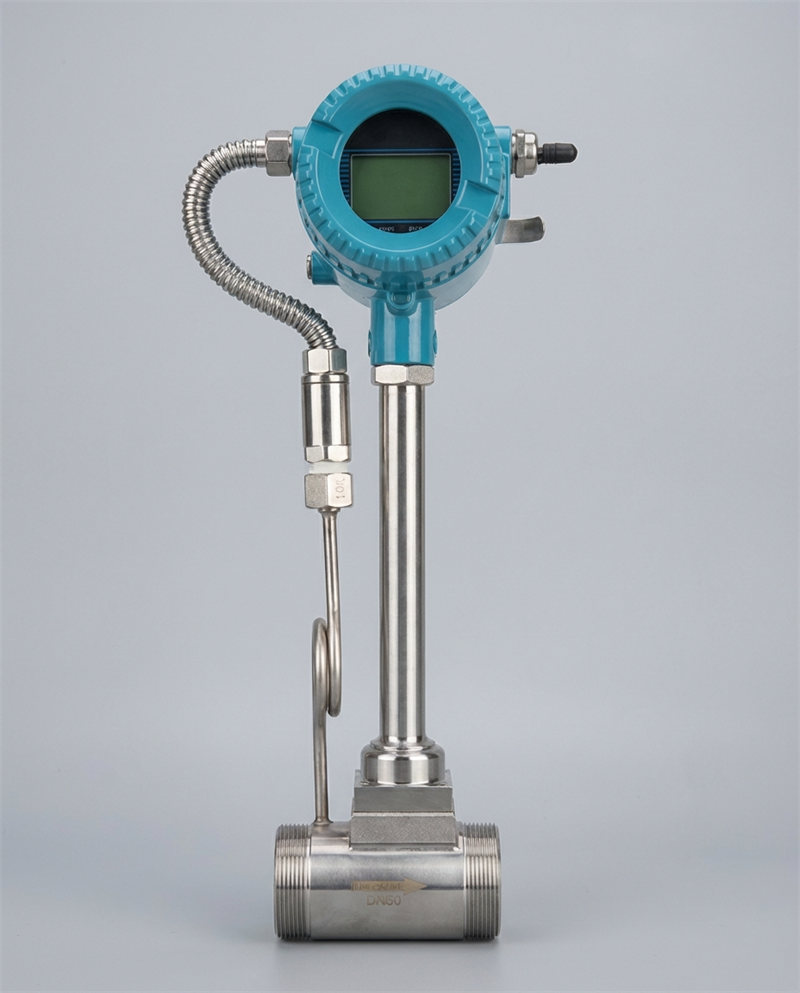
Vortex Flowmeters (Jade Ant):
- Measure flow by detecting vortices shed from a bluff body
- No moving parts – eliminates wear and maintenance
- Measure liquids, gases, and steam with the same meter
- Require minimum flow velocity to generate stable vortices
- Excellent for clean fluids but sensitive to contamination on sensor
- Work with conductive and non-conductive liquids (unlike magnetic meters)
Electromagnetic Flowmeters:
- Measure flow using Faraday’s law of electromagnetic induction
- Require electrically conductive liquids only (cannot measure gases, steam, or hydrocarbons)
- No flow velocity minimum – excellent for very low flows
- No obstruction – no pressure drop
- Best for dirty liquids, slurries, and wastewater
Turbine Flowmeters:
- Use rotating turbine whose speed is proportional to flow
- Moving parts require regular maintenance and eventual replacement
- Excellent accuracy for clean liquids only
- Cannot measure steam or gases accurately
- Sensitive to viscosity changes
When to Choose Jade Ant Vortex:
- Steam measurement (saturated or superheated)
- Clean gases (compressed air, nitrogen, natural gas)
- Clean liquids where no moving parts desired
- Multi-phase applications requiring one meter for liquid and gas
- High-temperature applications (up to 350°C)
- Long-term reliability without maintenance
For your specific application, Jade Ant applications engineers can help determine the optimal technology based on fluid properties, process conditions, and performance requirements.
Q2: Can Jade Ant vortex flowmeters accurately measure both saturated and superheated steam?
A: Yes, Jade Ant vortex flowmeters with integrated temperature and pressure compensation are specifically designed to accurately measure both saturated and superheated steam across a wide range of operating conditions.
Saturated Steam Measurement:
For saturated steam, temperature and pressure are interdependent – knowing one determines the other. Jade Ant vortex meters:
- Measure either temperature or pressure (both not required but recommended for verification)
- Automatically determine steam density from IAPWS-IF97 steam tables
- Calculate mass flow rate = volumetric flow × density
- Calculate energy flow using saturation enthalpy at measured pressure/temperature
- Typical operating range: 0.5-4.0 MPa (7-580 psi), 80-250°C (176-482°F)
Important for Saturated Steam: The meter assumes steam is dry saturated (100% vapor, no liquid droplets). If steam quality is less than 95% (wet steam with significant moisture), measurement accuracy degrades because:
- Liquid droplets do not generate vortices effectively
- Density calculation assumes pure vapor
- Actual enthalpy is lower than dry saturated value
Solution for Wet Steam: Install a steam separator upstream to remove moisture and ensure steam quality >98%.
Superheated Steam Measurement:
For superheated steam, both temperature and pressure must be measured because they are independent variables. Jade Ant vortex meters:
- Measure both temperature and pressure simultaneously
- Automatically detect superheated condition (temperature > saturation temperature at measured pressure)
- Look up density and enthalpy from superheated steam tables
- Calculate mass flow and energy flow accurately
- Typical operating range: Up to 16 MPa (2320 psi), 600°C (1112°F) depending on model
Advantages for Superheated Steam:
- More stable measurement (no condensation concerns)
- Higher energy content per kg of steam
- No wet steam complications
- Suitable for main steam to turbines, high-pressure process applications
Automatic Phase Detection:
Jade Ant vortex flowmeters automatically detect whether steam is saturated or superheated by comparing measured temperature to saturation temperature at measured pressure:
- If T = T_sat (within tolerance): Saturated steam mode
- If T > T_sat: Superheated steam mode
- Automatically selects correct property table and calculation method
- No user intervention required when steam conditions change
Accuracy Specifications:
- Volumetric flow: ±1.5% of reading
- Mass flow (with T&P compensation): ±2.0% of reading
- Energy measurement: ±2.5% (includes uncertainty in flow, T, P, and property tables)
This makes Jade Ant vortex flowmeters ideal for steam energy management, cost allocation, and performance monitoring across diverse industrial steam systems.
Q3: How do I properly size a vortex flowmeter for my application?
A: Proper sizing is critical for vortex flowmeter accuracy and reliability. Unlike some other technologies, vortex meters should generally be sized to match the pipe size, not downsized, because of their wide turndown ratio (40:1). Follow this systematic sizing procedure:
Step 1: Gather Application Data
Flow Rates:
- Maximum flow rate: Highest flow you’ll ever measure (consider upset conditions)
- Normal flow rate: Typical operating condition (most important for sizing)
- Minimum flow rate: Lowest flow requiring accurate measurement
Fluid Properties:
- Fluid type (water, steam, air, specific chemical, etc.)
- Operating temperature (minimum, normal, maximum)
- Operating pressure (minimum, normal, maximum)
- For liquids: Viscosity (especially if >5 cP)
- For gases: Molecular weight and compressibility
Pipe Information:
- Existing or planned pipe size (DN or inches)
- Pipe schedule (affects actual ID)
- Pipe material
- Flange standard (ANSI, DIN, JIS, etc.)
Step 2: Calculate Flow Velocities
For each flow rate (min, normal, max), calculate flow velocity in the pipe:
For Liquids: Velocity (m/s) = Volumetric Flow (m³/h) ÷ [Pipe Area (m²) × 3600]
For Gases and Steam: First convert mass flow or standard volumetric flow to actual volumetric flow at operating conditions, then calculate velocity.
Step 3: Check Against Velocity Limits
Compare calculated velocities to Jade Ant specifications:
| Fluid Type | Minimum Velocity | Optimal Range | Maximum Velocity |
|---|
| Water/Liquids | 0.5 m/s | 1-5 m/s | 7 m/s |
| Gases | 4 m/s | 8-40 m/s | 70 m/s |
| Saturated Steam | 5 m/s | 10-50 m/s | 70 m/s |
| Superheated Steam | 5 m/s | 15-60 m/s | 70 m/s |
Sizing Criteria:
- Normal flow velocity MUST fall within optimal range for best accuracy
- Minimum flow velocity must exceed minimum for stable vortex generation
- Maximum flow velocity must not exceed maximum to avoid sensor damage and erosion
Step 4: Determine Meter Size
General Rule: Select meter size matching your pipe size if normal flow velocity is within optimal range.
Example 1: Steam Application
Given:
- Pipe size: DN100 (4-inch Schedule 40, ID = 102.3mm)
- Steam flow: 2000 kg/h normal, 3500 kg/h maximum
- Pressure: 1.0 MPa (145 psi)
- Temperature: 180°C (saturated steam)
- Steam density at conditions: 5.16 kg/m³
Calculate volumetric flow:
- Normal: 2000 kg/h ÷ 5.16 kg/m³ = 388 m³/h
- Maximum: 3500 kg/h ÷ 5.16 kg/m³ = 678 m³/h
Calculate pipe area:
- Area = π × (0.1023m)² / 4 = 0.00822 m²
Calculate velocities:
- Normal velocity: 388 m³/h ÷ (0.00822 m² × 3600 s/h) = 13.1 m/s ✓
- Maximum velocity: 678 m³/h ÷ (0.00822 m² × 3600 s/h) = 23.0 m/s ✓
Recommendation: DN100 Jade Ant Vortex Flowmeter
- Normal velocity 13.1 m/s is in optimal range (10-50 m/s) ✓
- Maximum velocity 23.0 m/s is well below limit (70 m/s) ✓
- Excellent performance expected
Example 2: Compressed Air Application
Given:
- Pipe size: DN50 (2-inch)
- Flow: 300 SCFM normal, 500 SCFM maximum
- Pressure: 7 bar gauge (8 bar absolute = 116 psi)
- Temperature: 25°C
Convert to actual flow:
- Actual flow = Standard flow × (P_standard / P_actual) × (T_actual / T_standard)
- Normal actual: 300 SCFM × (1.013/8) × (298/288) = 39 actual CFM = 66 m³/h
- Maximum actual: 500 SCFM × (1.013/8) × (298/288) = 65 actual CFM = 110 m³/h
Calculate velocities for DN50 (ID = 52.5mm, Area = 0.00216 m²):
- Normal velocity: 66 m³/h ÷ (0.00216 m² × 3600) = 8.5 m/s ✓
- Maximum velocity: 110 m³/h ÷ (0.00216 m² × 3600) = 14.1 m/s ✓
Recommendation: DN50 Jade Ant Vortex Flowmeter
- Normal velocity 8.5 m/s is in optimal range (8-40 m/s) ✓
- Good performance expected
When to Consider Upsizing or Downsizing:
Upsize (select larger meter than pipe):
- Never recommended for vortex – creates low velocity and measurement instability
- If flow velocities too low, consider different technology (electromagnetic, thermal mass)
Downsize (select smaller meter than pipe):
- Only if normal flow velocity is significantly below minimum
- Requires pipe reducers upstream and downstream (adds cost and pressure drop)
- Generally not recommended due to wide turndown ratio of vortex meters
Special Sizing Considerations:
High Viscosity Liquids (>5 cP):
- Vortex performance degrades above 5 cP viscosity
- Consult Jade Ant for viscosity correction factors
- May require higher minimum velocity
- Consider electromagnetic or positive displacement for viscous fluids >20 cP
Dirty or Abrasive Service:
- Consider tungsten carbide coated vortex shedder
- Or select alternative technology (electromagnetic for dirty liquids)
Very Low Flow Applications:
- If minimum flow velocity cannot be achieved even in smallest meter size
- Consider thermal mass flowmeter for gases
- Consider electromagnetic or ultrasonic for liquids
Jade Ant Free Sizing Service:
Unsure about sizing? Send your application data to Jade Ant applications engineering:
- Fluid type and properties
- Flow rates (min, normal, max)
- Operating temperature and pressure
- Pipe size and material
- Performance requirements
We’ll provide:
- Recommended meter size with detailed calculations
- Performance predictions (accuracy, rangeability, pressure drop)
- Alternative options if applicable
- Formal quotation
- Response within 24 hours